The Day After Tomorrow Review





There are disaster movies that arrive with a bang and then there are disaster movies that arrive with a weather report. The Day After Tomorrow belongs to the second kind, and that’s exactly why it remains such a curiously watchable piece of Hollywood spectacle. Roland Emmerich has always had a talent for turning catastrophe into entertainment, but here he goes further than mere destruction. He builds a film around a very human, very relatable fear: that the world can change faster than we can understand it. The result is a global collapse movie that is as absurdly grand as it is strangely intimate.
What makes the film endure, even years after its release, is not scientific accuracy. Plenty has been said about the movie’s climate shortcuts, exaggerated timeline, and headlong indifference to nuance. But judging it by the standards of a documentary misses the point. This is a summer blockbuster that uses weather as a force of myth. Snow freezes streets in seconds, tornadoes swarm skyscrapers, and a continent-wide storm system barrels across maps like a punishment from nature itself. Emmerich’s imagination is not interested in realism so much as scale, and on that front the film remains impressive. Even now, it is difficult not to feel a spike of awe when the ocean surges through Manhattan or the temperature plunges with terrifying speed.
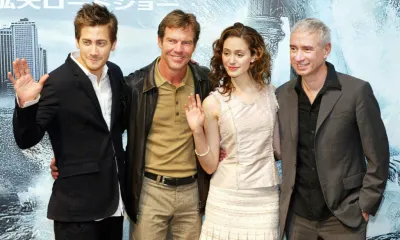
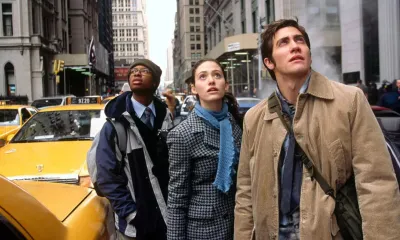
At the center of this spectacle is Dennis Quaid, whose role as Jack Hall gives the film a much-needed human anchor. Quaid has a fatherly steadiness that works well in a story where every other element is spinning out of control. He plays Hall as a scientist who is calm under pressure but not detached from feeling, and that balance matters. He is not written as a cold expert spouting exposition for two hours. Instead, he becomes a parent first and a climatologist second, which gives the character emotional urgency. Jake Gyllenhaal, still early in his career at the time, brings a scrappy charm to the role of Hall’s son Sam. The character is written as a typical resourceful teenager, but Gyllenhaal gives him enough sincerity to avoid becoming a cartoon. His scenes in New York, particularly once the city becomes an iced-over trap, provide the movie’s most suspenseful momentum.
The film’s structure is split between the global and the personal, and that division is one of its strengths. On one level, The Day After Tomorrow wants to show a planet entering a new ice age in rapid succession, and it does this with enormous visual confidence. On another level, it is a rescue story about a father trying to reach his son. This dual design helps the movie avoid becoming too remote. Without the family thread, the destruction would risk feeling like a series of disconnected effects. With it, the audience has a route into the chaos, even when the story itself becomes increasingly schematic.
That said, the screenplay is not subtle, and it never aims to be. Characters explain things in broad strokes, often with the kind of urgency that feels engineered more for pacing than for natural speech. The government officials, scientists, and media figures all function as channels of panic, and they are written more as types than as fully developed people. Yet there is an efficiency to this approach. The movie does not pause long enough for elegance, and perhaps it cannot afford to. Once the storm begins to intensify, the film has the momentum of a runaway machine. Its pleasures are visceral rather than literary.
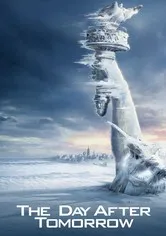
One of the most memorable aspects of the film is its visual language of scale. Emmerich and his effects team understand that disaster cinema works best when it allows the audience to grasp the enormity of the event through contrast. Tiny human figures in enormous civic landscapes. Cars swallowed by water. Libraries turned into frozen caverns. Statues, bridges, highways, and office towers all become props in nature’s spectacle. The movie’s best sequences do not just destroy things; they transform familiar urban spaces into alien terrain. New York, in particular, becomes a frozen nightmare landscape, which taps into a deep cinematic tradition of watching a familiar city become unrecognizable.
There is also a romanticism in the movie’s attitude toward survival. Not the romanticism of beauty, exactly, but the romanticism of human ingenuity under pressure. Characters improvise, improvise again, and then improvise one more time. They barricade doors, burn books for heat, and make desperate choices in impossible conditions. The film often embraces a kind of old-fashioned competence porn, where problem-solving becomes heroic in itself. That trait gives the movie a surprisingly comforting rhythm beneath its chaos: the world may be collapsing, but people can still act with purpose.
Still, it’s hard to ignore the movie’s melodramatic impulses. The score pushes hard, the dialogue pushes harder, and certain scenes are arranged with the emotional bluntness of a disaster soap opera. Yet I would argue that this excess is part of the film’s identity rather than a flaw to be apologized for. Emmerich does not believe in restraint when he can believe in spectacle. He wants the audience to lean in, to feel the pressure of each crisis, and to be swept up by the absurdity of the premise. The movie’s emotional directness may not always be elegant, but it is effective. You know exactly what each scene wants from you, and the film rarely wastes time pretending otherwise.
What is most interesting, in retrospect, is how the movie sits at the intersection of environmental anxiety and pop entertainment. Watching it now, the climate anxiety feels more resonant than ever, even if the science remains wildly elastic. The film’s vision of abrupt consequence, system failure, and public confusion speaks to a broader cultural unease that periods of relative calm often disguise. In that sense, the movie has aged better emotionally than intellectually. Its warnings are blunt, but its mood has proven durable. We may not believe in its mechanics, but we understand its fear.
The cast around Quaid and Gyllenhaal does their share of heavy lifting, even when the material is thin. Ian Holm brings gravitas to the academic side of the story, and Sela Ward gives the media and political response a grounded edge. The ensemble is not built for deep character study; it is built for momentum, and each actor helps keep the machinery moving. The film also benefits from its willingness to stage large-scale human panic without overcomplicating it. There is urgency in the crowds, in the broadcasts, in the evacuation sequences, and that collective anxiety gives the movie texture.
As a piece of filmmaking, The Day After Tomorrow is more impressive when viewed as a controlled catastrophe than as a story of scientific realism. Emmerich understands how to organize visual disaster into digestible waves, each one bigger than the last. He also understands that audiences do not go to this kind of film for subtle argument. They come for tension, scale, and the fantasy of surviving the unthinkable. On that level, the film delivers with relentless confidence.
If this were merely an effects reel, it would have faded long ago. What keeps it alive is the combination of spectacle and sincerity. The movie takes itself seriously enough that the danger feels weighty, but not so seriously that its lunacy becomes burdensome. That balancing act is harder to pull off than it looks. Many disaster films try to outdo one another with noise. The Day After Tomorrow at least has the sense to know that noise needs a pulse, and that pulse comes from family, urgency, and the primal terror of a world turned suddenly inhospitable.
It is not a sophisticated film, and it does not pretend to be. But it is an expertly tuned disaster fantasy with enough nerve to be memorable and enough scale to justify its own excesses. If you want airtight logic, look elsewhere. If you want a storm movie that amplifies anxiety into entertainment, this one remains highly effective. It is the kind of blockbuster that invites you to watch its impossible weather, stream it if you’re in the mood for spectacle, or even download it for a future rewatch when you want pure, icy chaos. However you access it, the film still lands with the force of a cautionary tale dressed as a thrill ride.
How to watch The Day After Tomorrow online
The Day After Tomorrow is typically available to watch online through major rental and purchase platforms rather than as a permanent free title. Availability can shift by region, so some platforms may offer it on subscription at certain times, while others may require a paid rental or purchase.
Age Rating: PG-13 in the US. The film contains intense disaster sequences, peril, and some frightening imagery, so it is best for viewers under 13 only with parental guidance.
Netflix: Availability varies by country and time. If included in your region, it may be streamable under a subscription; download access depends on the app and plan.
Amazon Prime Video: Commonly available to rent or purchase, with offline access through the app for eligible downloads. Sometimes offered through add-on channels or limited subscription windows.
Apple TV: Usually available to buy or rent in HD or higher quality. Downloads are supported through the Apple TV app after purchase or rental.
Peacock: Library access changes frequently. If available on premium tiers, offline download conditions depend on the subscription level and app restrictions.
Hulu: Streaming availability is region-dependent and may require a subscription. Download options are limited to supported plans and devices.
YouTube (Movies): Often available to rent or buy, with playback in the app and download access on supported devices for offline viewing.
Pros
- Strong visual spectacle with memorable large-scale disaster sequences
- Effective mix of global catastrophe and a personal father-son rescue story
- Dennis Quaid gives the film emotional grounding and steadiness
- Jake Gyllenhaal adds sincerity and charm to the younger storyline
- The movie creates intense suspense and strong pacing once the storm begins
- Its frozen New York imagery is iconic and visually striking
- The film captures modern climate anxiety in a dramatic, accessible way
- The disaster scenes are creatively staged and easy to follow
Cons
- The science is highly exaggerated and often unrealistic
- Several characters feel thinly written and more like story functions than real people
- The dialogue can be heavy-handed and overly melodramatic
Screenshots