Instadocs: Jane Doe v. Cornell Review





Content note: this review discusses allegations of sexual assault. The case described is ongoing, and no one accused has been found responsible in court.
When a student reports sexual assault at an American university, two systems are supposed to respond: the police and the school's Title IX office. Instadocs: Jane Doe v. Cornell asks whether those systems work. The short Netflix documentary, which premiered on October 29, 2026, looks at one case that has made that question impossible to ignore at Cornell University.
At just 35 minutes, it's more of a focused report than a full investigation. Here's what it explores, who it hears from and how critics have responded.
Two systems under the microscope
Netflix's description lays out the film's central concern. It examines "campus police and Title IX, the process for reporting sexual misconduct at most U.S. universities." Then it adds the key detail: "Jane Doe tried both, and the outcry over her case has pressed the question: are they delivering on that promise?"
That framing gives the documentary a purpose beyond a single case. It's less about retelling events and more about asking how institutions treat students who come forward.
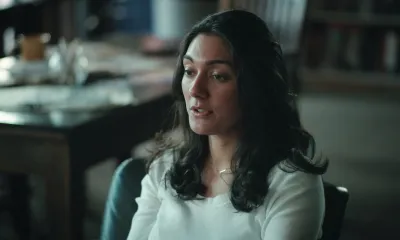
Amanda Walsh helps explain those systems. She is deputy director of the Victims Rights Law Center and a former Title IX coordinator at Brown University. The film also hears from a recent Cornell graduate who went through the Title IX process, according to The Viewer's Perspective.
A quick primer on Title IX
For viewers outside the U.S., some background helps. Title IX is a federal law that bans sex-based discrimination in schools receiving federal funding. Under it, colleges must respond to reports of sexual harassment and assault, usually through an internal investigation that runs separately from any police case.
The two processes have different goals and standards. A campus investigation can lead to discipline such as suspension or expulsion, while criminal charges depend on prosecutors and the courts. Students often find it hard to know which path to choose, or whether to try both. That confusion is exactly what the documentary asks viewers to think about.
The allegations
The plaintiff, a former Cornell student, is identified only as Jane Doe. Netflix reports that she alleges she was drugged and raped at a fraternity house on campus in October 2024. According to the Boston Globe, her civil lawsuit alleges she was assaulted by seven fraternity members.
She does not appear in the film, and her identity remains protected. Her attorney speaks on her behalf. The seven accused men declined to take part, the Globe reports.
Because the case is unresolved, the claims in the film remain allegations. That's worth keeping in mind throughout.
A governor and a campus
The story drew attention far beyond Ithaca. New York Governor Kathy Hochul appears in the documentary, a sign of how much political weight the case has gained.
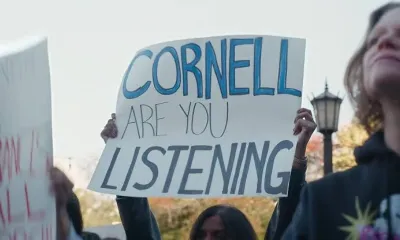
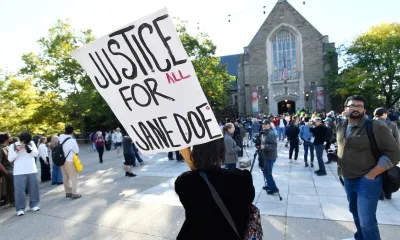
The Viewer's Perspective notes that it led to protests on campus and "a broader debate over how colleges investigate and respond to allegations of sexual assault." Other Cornell students share their reactions, and the Globe reports that a member of a different fraternity gives a long interview about campus culture.
The student editors who broke it open
Much of the film is told through the eyes of The Cornell Daily Sun. Sophia Dasser and Cereese Qusba, editors at the student paper, walk viewers through how their reporting unfolded.
It's a reminder that local and student journalists are often first on the scene. They know the campus and its pressures in a way national reporters don't. The documentary treats their work with respect, and it shows the weight of covering a story this serious while still being students themselves.
Speed as a format
Jane Doe v. Cornell is the fifth entry in Instadocs, a Netflix series launched in 2026 to cover major stories while they're still developing. Netflix's Tudum says each installment aims to "move at the speed of each real-life story." Earlier films covered subjects such as the Alex Murdaugh case and artificial intelligence.
The production company is Words + Pictures. Josh Tyrangiel and Connor Schell are among the executive producers, and Steve Yaccino is the showrunner.
Speed brings obvious benefits. The film reaches viewers while the debate is happening, not years later. It also has costs. Facts may still change, and a 35-minute runtime leaves little room for complexity.
Critical response
The Boston Globe's Chris Vognar gave the most thorough review. He called it "a brisk, thoughtful report on a story still unfolding day by day" and said the format "gives viewers the gist of the story in a responsibly produced capsule form."
He compared it to PBS's Frontline and acknowledged that it can't match that depth. He still ended on a positive note: "Here's hoping for a follow-up."
Decider's John Serba saw it in similar terms, writing that it "isn't far removed from a longer news story we'd see on CNN." An early audience review on Rotten Tomatoes called it "Well put together and thought-provoking." The site had no critic score at the time of writing.
Difficult viewing
The Globe noted that the film shows messages allegedly sent by the accused men on the night in question. These are disturbing, and some viewers may want to know that in advance.
For anyone affected by sexual violence, the documentary could be painful to watch. Support is available through organizations such as RAINN, which offers confidential help in the U.S.
Who will find it useful
Students and parents weighing how colleges handle these cases will find it relevant. So will anyone interested in how journalism works on a college campus.
Viewers who want a full investigation may come away wanting more. The film is better at raising questions than answering them, which fits a case that's still moving through the courts.
My take
I think the documentary's most important contribution is the question it puts to universities. The answer matters far beyond Cornell.
I would treat it as an early chapter. The legal process is ongoing, and the people involved deserve a full and fair outcome before anyone draws firm conclusions.
Pros
- Smart, formally inventive approach that uses documents, filings, and testimony as part of the storytelling.
- Strong thematic focus on institutional power, reputation management, and the difficulty of finding clarity in public disputes.
- Measured tone that avoids cheap melodrama and lets tension build naturally.
- Respects ambiguity and complexity instead of forcing an overly neat verdict or moral conclusion.
- Sharp attention to the language of official statements and how institutions use wording to deflect scrutiny.
- Engaging editing and structure that keep the material intellectually active and suspenseful.
- Ethically aware treatment of sensitive subject matter, especially in how it handles the anonymity and presence of Jane Doe.
- Feels timely and relevant to current conversations about accountability, media narratives, and institutional behavior.
Cons
- Occasionally repetitive, especially when revisiting the same institutional dynamics from similar angles.
- Its restraint may feel too subdued for viewers expecting a more dramatic or emotionally direct documentary.
- The deliberate ambiguity can leave some viewers wanting more concrete answers or closure.
- A few procedural sections linger longer than necessary and slow the pace slightly.
Screenshots