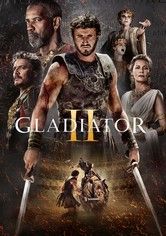
Gladiator 2 Review


Gladiator 2 arrives with the kind of title that instantly summons memory, skepticism, and expectation in equal measure. Any sequel to Ridley Scott’s 2000 epic has a brutal task: it must honor a film that became larger than its own genre while also proving it has a reason to exist beyond nostalgia. What makes Gladiator 2 interesting is that it does not try to imitate the emotional architecture of the original scene for scene. Instead, it returns to the arena with a different agenda, one that is less interested in repeating a fallen hero’s journey and more concerned with asking what empire does after it has already devoured its legends.
The result is a film that feels both familiar and disorienting. Familiar in its scale, textures, and moral fury; disorienting in the way it treats history not as a museum display but as a machine that keeps grinding up bodies, loyalty, and language. The movie understands the spectacle people came for, but the stronger material lies in its awareness that spectacle itself is a political tool. In that sense, Gladiator 2 is not purely a return to swords-and-sandals grandeur. It is a study of inheritance, corruption, memory, and the uneasy work of making personal identity out of imperial ruin.
A sequel that understands the weight of a legend
One of the film’s smartest decisions is that it refuses to treat the original as an untouchable shrine. The shadow of Maximus is everywhere, but the script does not lazily rebuild him through resemblance alone. Instead, it explores the emotional consequences of his myth. History in this universe has become propaganda, and that alone gives the sequel a strong dramatic purpose. The central characters are forced to live in a Rome that has made a commodity out of heroism and a stage out of suffering.
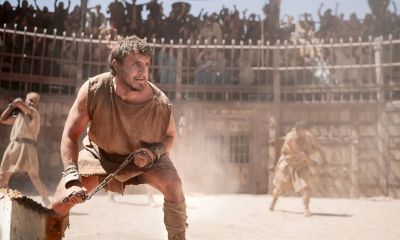
That idea gives the movie a richer political pulse than many modern epics. The gladiatorial games remain visually intoxicating, but they are also grotesque theater, a manufactured outlet for public appetite and state power. The sequel repeatedly returns to this tension. The arena is thrilling because the movie knows how to stage action, yet it is disturbing because every victory feels tainted by the system that arranged it. Few mainstream films manage to keep both sensations active at once.
Performances that carry the film’s emotional burden
The cast works hard to make this far more than an exercise in brand extension. There is a weathered urgency in the performances, as if every character is aware that Rome consumes even the people who think they control it. The lead role is written with enough internal pressure to avoid becoming a simple avatar of vengeance. Rather than presenting a character who is merely strong or merely brooding, the film gives us someone shaped by grief, political contamination, and the need to find purpose in a world that has already compromised every clean motive.
Supporting roles add necessary friction. What the original Gladiator excelled at was its gallery of powerful personalities, and this one continues that tradition, though in a different key. The courtly figures, military operators, and opportunists around the protagonist are all useful because they make the world feel systemically corrupt rather than villainous in a cartoon sense. That matters. The best scenes come when ambition, ideology, and fear collide in polite conversation before spilling into violence. Those moments remind us that Rome is not simply barbaric; it is sophisticated about its barbarity.
Ridley Scott’s visual command is still formidable
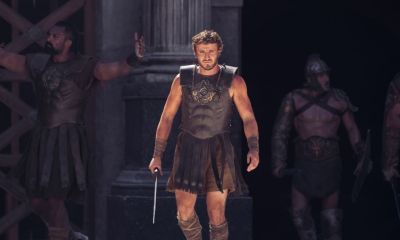
Even when the screenplay leans toward familiar beats, the direction keeps the film alive through sheer visual authority. Ridley Scott remains one of the great image-makers of cinema, and Gladiator 2 benefits from that mature confidence. He knows how to frame people against architecture so that power feels physical, not abstract. Stone, dust, bronze, blood, and light are all used as dramatic substances rather than ornamental decoration.
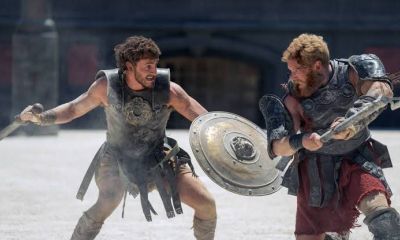
The action itself is staged with clarity and menace. The film does not confuse frenzy with excitement. Instead, it builds sequences that are legible in space, allowing the viewer to feel the geography of conflict while still absorbing the chaos. That balance is important, especially in a genre where editing can so easily become a blur. Here, the combat scenes have a ritual quality. They are not just set pieces; they are arguments about dominance, spectacle, and survival.
At the same time, Scott gives the movie a tactile decay that keeps Rome from becoming glamorous in any simple sense. The city glitters, but it is a glittering rot. Even its triumphs look temporary. That atmosphere does much of the film’s thematic work and is one reason the movie lingers after the plot machinery has done its job.
The script has ambition, even when it reaches too far
If Gladiator 2 occasionally feels overstuffed, that may be the price of its ambition. The film wants to be a revenge story, a political drama, a meditation on inheritance, and a sequel burdened by cultural memory. Not every one of those strands receives equal development. Some plot turns land with more force than others, and there are stretches where the movie seems to hurry from one grand statement to the next.
Yet even its unevenness is revealing. The film is clearly trying to say something large about empire and the recycling of violence through institutions that claim to civilize it. It is less elegant than the original in how it structures that argument, but the ambition itself is admirable. There are modern blockbusters that make no effort to say anything beyond “look how much money is on the screen.” Gladiator 2 at least wants to wrestle with history, memory, and the moral residue of public power.
Emotionally, the movie works best when it trusts silence, expression, and atmosphere over speechifying. The more it leans into those qualities, the more it feels like a worthy descendant of its predecessor. When it leans too hard into explanation, the spell weakens. Still, the film’s missteps are those of a project reaching for something substantial, which is preferable to a sequel that merely imitates a famous shape.
How the film compares to the original
It is almost impossible, and probably unfair, to watch Gladiator 2 without measuring it against the 2000 film. The original had the advantage of surprise and a tightly calibrated emotional arc. This sequel cannot recreate that experience, nor should it try. What it can do is extend the world in a way that feels thematically meaningful. On that front, it succeeds more often than not.
The new film is colder, more politically explicit, and in some ways more tragic because it is less concerned with mythic closure. Rather than offering the comfort of a complete legend, it suggests that systems outlive individuals and that identity in Rome is always temporary, borrowed, or imposed by force. That is a less crowd-pleasing idea, but a smarter one. It makes the film feel adult in the best sense: not merely violent, but aware of the cost of violence.
As entertainment, it delivers the expected grandeur. As sequel craftsmanship, it may not match the perfect inevitability of the original. But as a serious piece of blockbuster filmmaking, it stands apart from most studio epics because it understands that the past is not just something to honor. It is something to interrogate.
Final verdict
Gladiator 2 is not a film that exists to casually charm you. It wants your attention, your memory of the original, and your willingness to sit with a story about power as inheritance and spectacle as control. Some viewers will come looking for the emotional purity of the first film and find this sequel more guarded, more political, and less immediately cathartic. That reaction is understandable. But for those willing to meet it on its own terms, the movie offers a rich, visually commanding return to a world where glory is always stained and survival is never innocent.
It may not surpass Gladiator, but it earns its place by refusing to be merely decorative. It is a large-scale historical drama with enough force, craft, and thematic bite to justify its existence. In a landscape crowded with disposable franchise extensions, that already feels like a notable achievement.
How to watch Gladiator 2 online
Gladiator 2 is expected to be available on major streaming platforms after its theatrical and premium digital window, though availability can change by region. It is typically not free at launch, and most viewers will need a subscription or rental purchase to watch or stream it online. Some platforms may offer offline download options through their apps once it appears in the catalog.
US age rating: R. The film contains intense battle violence, bloody combat, and mature themes, so it is intended for adult viewers and those under 17 only with an accompanying adult.
Netflix: Availability may vary by country and release window. If it arrives, access will require a subscription; downloads are usually available on supported devices for offline viewing.
Amazon Prime Video: Commonly offers rent or purchase options first, with offline access through the app after purchase. A Prime subscription may not be required for digital rental or buying.
Apple TV: Usually provides high-quality rent or purchase options, including 4K where available. Downloads are generally supported after purchase through the Apple TV app.
Peacock: If the film becomes available here, it will likely be tied to premium access rather than free viewing. Download availability depends on plan and device support.
Hulu: Availability is not guaranteed and may depend on licensing. If included, watching usually requires a subscription, with download limitations based on plan and device.
YouTube Movies: Offers rent or buy access in many regions. Downloads are possible through the YouTube app for eligible purchases on supported devices.
Pros
- Strong visual command and large-scale spectacle
- Smartly expands the world of the original film
- Themes of empire, memory, and inherited power feel substantial
- Action scenes are clear, tense, and well-choreographed
- Performances carry real emotional weight
- Production design creates a convincing sense of Roman decay and grandeur
- The film respects the legacy of Gladiator without simply copying it
Cons
- The plot can feel overstuffed and uneven
- Some emotional beats are less effective than in the original film
- A few scenes lean too much on exposition
- It may not satisfy viewers expecting the same impact as Gladiator
- Certain character arcs could use more development
Screenshots